
Leaderboard
-
Sawbonz
Certifiably Surly120Points16169Posts -
wildcat09
Full Members101Points13875Posts -

atomheartbevo
Certifiably Surly89Points63425Posts -

Brisketexan
Legacy Members81Points56128Posts




Popular Content
Showing content with the highest reputation on 05/10/22 in all areas
-
Jordan fucking Addison is in town and y’all are fucking around in some sissy slap fight about Malcolm fucking Epps. FFS, can we get some fucking transfer news in this fucking transfer thread.42 points
-
Would like to throw in that Lamborghini Austin is following Jordan Addison on instagram.36 points
-
33 pointsDon't worry about the laws my party is trying to pass because they're so deplorable reasonable minds will prevail isn't the defense you think it is.33 points
-
28 pointsA miscarriage is an abortion. It’s just not a medically induced abortion -signed, guy with actual medical degree28 points
-
27 pointsThank you. I mean, it is already routine that the insurance company is involved in my healthcare, but praise be that the State was not in the room when I had to call my spouse at his work and place one of those phone calls that I hope to hell you all never receive. You married fathers out there? The ones with several children? Let's say the oldest of your offspring is in kindergarten and your spouse, pregnant in the first trimester, is at a regular wellness visit and the doctor discovers a lump in her breast tissue and wants her to see a specialist to make sure everything is okay. So she calls you at work, hating to do it, but figuring it's better to talk while the children are in school and preschool. Do you want to know how hard it is in the first trimester of a pregnancy not to cry and to keep calm on the telephone when making that call? That specialist (bless him, he was so kind) had to have some difficult conversations with the two of you and it is (and was) a very emotional time. I'm not going to go further with that anecdote, but now, just imagine if Greg Abbott and Dan Patrick were able to sit in the room and weigh in on the State's opinion regarding your spouse's PERSONAL healthcare and remove any choice in the matter whatsoever. Or, if the State were to say, "well, the vessel is damaged, so if she dies, you can just get a new one to raise all your children." They would rather my children freeze to death in February after they're born so they can make billions than protect my right to privacy when my family is faced with medical decisions such as this. The cruelty is the point. Dammit. I hate the ledge at this point. It's not high enough.27 points
-
26 points
-
23 pointsPrivate Citizen Beto O'Rourke 3 years ago during a speech "Hell yes we're going to take your AR-15." Conservatives here: "That comment rightfully torpedoed any political future for him." Multiple GOP legislators today "we believe the State should execute a woman if they have an abortion." Conservatives here: "oh please, calm down. you're being hysterical. That will never happen." One conservative here: "mods, please remove me from this forum. People are mean to me and I lack the self-control to stay away."23 points
-
Oh, you mean you don’t have a Lamborghini dealership in Tuscaloosa? Huh22 points
-
20 pointshttps://www.npr.org/2022/04/10/1091927639/a-texas-woman-has-been-charged-with-murder-after-a-so-called-self-induced-aborti Motherfucker, our fucking state jailed and processed a woman who had just miscarried because they suspected she may have had a pharmaceutical abortion. Put her under a $500,000 bail bond. Sure, the charges got dropped but that just means the system isn't totally fucked yet. The thugs on the ground still reported her, the police booked her, and subjected a woman who had already lost a child to brutal dehumanization. Eat a fat bag of dicks and die in a fire you goddamn willfully ignorant liar20 points
-
20 pointsHad a great video call with 1LT Bearschlong somewhere in Poland yesterday. He didn't tell me much but he looked good.20 points
-
19 points19 points18 pointsStats, number of abortions someone has had, etc is all filler. The bottom line is that no one has access to use your body without consent. Not the government, not a fetus, not a doctor - no one. That’s what is on the chopping block. That goes away and Pandora’s box opens for government fuckery.18 points16 points16 points16 points16 pointsI am never going to vote for a party that advocates for suppressing a person’s right to vote. I’m never going to vote for a party that supports violent insurrection in response to an unwanted outcome from a free and fair election. I am never going to vote for a party whose members introduce legislation to put women in jail for using contraception or terminating pregnancies before 17 weeks. If you think that makes me a liberal you need your head examined.16 points15 points15 points15 pointsHere's some more recent and relevant data: In 2019, 79% of abortions in Texas occurred during the first 9 weeks when still just an embryo (not yet even a fetus). Another 14% occur in the next three weeks. If you're counting, 93% of abortions occurred during the first trimester. I'm sorry to offend anyone by saying that I have zero problem for a woman to terminate a first trimester pregnancy for any reason she wishes. If we feel like those need to be reduced, then let's promote robust sex education courses in the public schools and ensure universal access to the myriad means of birth control. Edit: I'm not going to engage in any meaningful discussion with anyone who is opposed to abortion during that first trimester, because I believe that opposition is likely rooted in mysticism and/or religious belief. It's simply an imposition of your religion on others.15 points14 points14 points14 points14 points14 pointsrespectfully, this is not an answer...at least not a relevant one to this topic at hand. this is effectively a handwave with non-specific vagueries that, if i simply changed a few words, could easily be turned into a bland, non-specific coachspeak solution to drug dependency...another issue in which criminalization impacts the effectiveness of combating its abuse. the question at hand is the supreme court overturning roe v. wade and its implications on abortion and women's rights in this country. that is what is being discussed (and occasionally debated) here in a thread about the supreme court. you say we "can't and should not count on the government" for a solution to the issue of abortion. roe v. wade essentially said the same thing...that it is not an issue of government because it is not a criminal act and an issue of privacy (something i believe, based on your postings, you care deeply about in other contexts). it affirmatively held that, for the most part, it is an intimate issue for the woman and her doctor and not the domain of the state. not an issue for the state or for the benefit of political opportunism. however, the ussc is removing that federal protection and making it possible for states to criminalize the action...and thus, has ostensibly made it almost entirely part of the government's domain through putative criminal prosecution on behalf of the state. so which is it, anastasis? we live in a country of laws that define the rules of behavior as a baseline. you can't handwave the importance of that away by just saying "hey, this isn't an arena in which a legal solution is the best way of dealing with the underlying problem." well no shit, but when the state criminalizes it (and even sets forth civil penalties), then that necessarily defines categorically...how the complex issues can even be addressed. discussion/debate/rage/etc... about the ussc establishing that states can impose laws establishing the criminality of the act is not being discussed as a "legal solution." it is a baseline paradigm in which the issue exists for how our society treats those individuals and it inherently defines that options and rules on how it can be dealt with, regardless of anyone's desired outcomes. the issues are complex as you acknowledge. outright criminalizing abortion simplifies those complex issues instantly. you can't ignore that and act superior because other people are outraged that the "solution" (lack of federal protection against regional criminalization) is now the law of the land because alito, kavanaugh, gorsuch, barrett, and thomas think tradition is the appropriate legal standard. what you are talking about is akin to drug rehabilitation...that we need to mitigate and end as many abortions as we possibly can in as humane a way possible. clearly you see abortions as heinous and undesirable. you obviously associate judgment with them (hence your opening characterization of "convenience" as if that should carry some shame). fine. while there are certainly some circumstances in which i might agree with such a characterization, i simply don't share that perspective categorically and believe the first trimester abortions in particular, are simply not a problem. that is not to mitigate the impact that undertaking them may or may not have on the woman and/or partner, but criminalizing it (or making them liable to random other citizens in civil court) certainly does not aid the well-being of those who are faced with that path. how can we work on any type of solution if that is the contextual paradigm? you want to focus on the real world praxis of abortion to arrive at the best possible outcomes for society as it relates to abortion...i applaud that and welcome that. how does allowing texas, lousiana, tennessee, florida, mississippi, etc... making something that has been demonstrated to be unavoidable from a practical sense potentially a prosecutable homicide going to aid in that process? this is the source of the histrionics that you mock. i am happy to disengage the issue from politics (i desperately wish it would) and seek out a common ground solution in which we can mitigate the extremes and/or abuses of abortion activities. the problem is that your party was hijacked many years ago by the jerry fallwells of the world and the issue was seized upon by hypocritical, political opportunists to leverage as a mobilization tool (admittedly, by both extremes but the comparison is not remotely equitable). and that has now been fully realized in a real-world context that has real-world consequences. if you want to live in the real world, and address it in a humane way that prioritizes education and avoidance in an effective way, you can't ignore the destructiveness of this decision (and its regional consequences) in building that bridge to reach more nuanced, empathetic, and compassionate (non-legal) solutions to your desired reduction in scenarios where unwanted pregnancies call for abortions. i note that in your post that you do acknowledge the overturn is counterproductive and will exacerbate the toxicity despite you disagreeing with roe in the first place. so, take a stand. should it be protected by the federal government as a baseline right to privacy for a woman and then addressed outside the legal context? or should states be free to let the greg abbotts and ken paxtons of the world decide what is best? in another thread, i would welcome a more specific discussion of your ideas on "building common ground and working outwards" (unclear on what that means) with serial abortion individuals but in this one, the issue is whether or not the federal government should protect women from their state governments seeking criminal action against them for any type of abortion.14 points13 points13 points13 pointsAs I posted above, I have a need to dig a few holes on our place, but before that happens I'll tell a story on one of my favorite holes on our place and one that I currently hate the most. This took place back in December of 2012. We have a 12 acre lake on our property that was built back in 1952. I grew up coming over to the property, fishing and duck hunting on our little lake and hunting squirrels in our creek bottom (that was about 100 acres of native pecan trees) below the lake. In the '80s, a large reservoir was built and when it filled it flooded that hundred acres of pecan trees. The normal spillway elevation of our little lake is about 16' above the elevation of the big lake. The spillway is constructed of 3 4' joints of 36" dia concrete pipe for the vertical and 12 joints of 24" for the horizontal. The outlet of horizontal pipe falls 4' into a small pool, which then flows down the old creek bed until it hits open water of the big lake. After a good rain and the lake level is up a couple of feet, there will be a 2' dia water jet from the outlet. This water tends to wash the tar between the pipe joints which then started the pipe to crack and the joints to widen. Normally there is some seepage between some of the vertical joints and the pipe always has a trickle of water. But, with it being so dry that fall, the lake level was down 5+' and the pipe was dried up. Dad had wanted to check out the pipe and unknown to the rest of the family had crawled through it a week before to inspect the pipe and see if it needed some repairs. We were up at the place for the opening of duck season and after shooting a few birds that morning dad mentioned he'd like to go see about repairing some spots on the pipe. We got some caulking tar and some mortar mix and headed down in the hole. Dad went down in the hole and into the horizontal. I went down to the bottom of the vertical and my buddy and son mixed up mortar and lowered to me in a bucket and then dad pulled another bucket with a refill back and forth from me. Oh yeah, here's a pic of my Dad when he was done. He turned 80 the following month. Lake and spillway Vertical section Horizontal section, you really can see light at the end of the tunnel old gopher

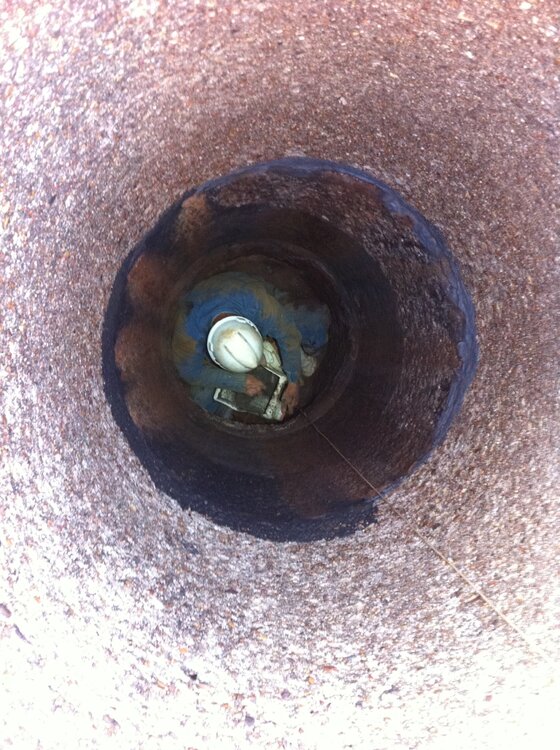
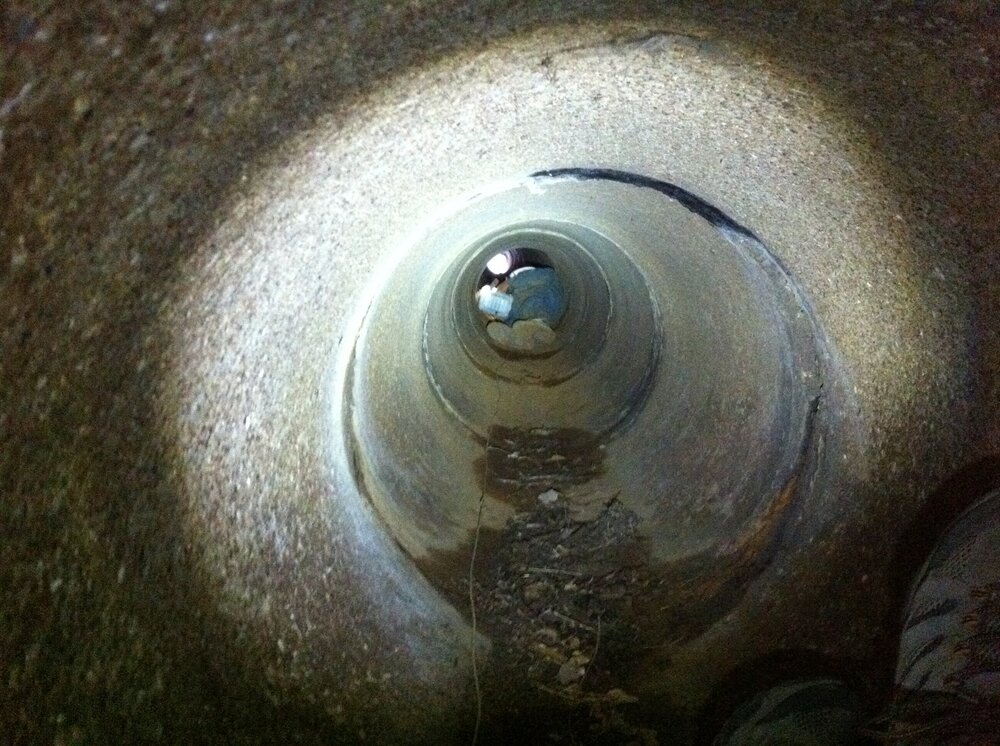
 13 points13 pointsActually you are only half-correct. It is not the conservative angle that she is negging, but rather the disingenuous angles that she is negging. That most of you self-proclaimed conservatives line up with the latter definition is why you are in her cross-hairs. Yes this is an emotional discussion for her because it directly impacts her. It is an emotional discussion for others because it can directly impact them as well. We have had folks on here express how they are discriminated against, but because we couldn't see it, we couldn't understand. That gay marriage became protected, it was a huge deal for them and the threat of repeal amounts to the stripping of their rights. I am of the belief that none of you are actually conservatives. It is just a moniker that you wrapped yourself in, without any understanding of its meaning. I think looking to the old ways of solving problems is a good strategy for understanding how people did it in the past and how to use that as a stepping stone to our future. This is great when we had to design the M1 helmet (by using studying the technology of medieval helmets) but ancestor worship has its trappings, especially when mysticism comes into play. Furthermore, do you think it is very conservative or traditional of you to argue with a woman online or to say nasty things to her with DMs? The reason you do not illicit respect is because you do not warrant it, and you do not command it. I think you are a bit thin skinned. I think like most self-proclaimed conservatives you do not understand what that word means. I think like most right wingers, you are fine with turning a blind eye to blatant fuckery and corruption within your own party because probably the others are doing it as well (they are not). I think something in your brain makes you desire to be ruled and support dictators. I think you are fine with harming others because you see yourself as the real victim. I think you are fine with killing democracy because it is your side that is doing it. I think you are fine with revisionist history because the truth is unkind to you. The right to the domain over one's body has to be part of the law. The right to privacy has to be part of the law. Life, liberty, and property are repeated in the the Bill of Rights (or Life, Liberty and the Pursuit of Happiness -> Declaration of Independence). Abortion impacts the woman's life. It impacts her liberty, and impacts her property (money) and her most precocious property, her body, and her happiness (not having a kid she doesn't want). How you self-proclaimed conservatives overlook simply tells me that you are not conservatives. You can lawyer it up all you want but it is right fucking there in the Declaration and the Constitutional Amendments.13 points12 points12 pointsReceivers Herman signed while he was here: Jordan Pouncey (late addition to the 2017 class)- lol Brennan Eagles- lol Al'Vonte Woodard- lol Joshua Moore- lol Bru McCoy- lol Jordan Whittington- Good player when healthy Jake Smith- lol Marcus Washington- I guess he at least lasted 3 years in the program Kennedy Lewis- lolol Tarik Black from the portal- hahahah Troy Omeire- Hasn't played one snap Kelvontay Dixon- lol Dajon Harrison- lol Jaden Alexis- Hasn't played a snap Casey Cain- Hasn't played a snap You have to be purposely tanking a program to be as bad as he was at evaluating that position12 points12 pointsWhile you search for truth on that one go ahead and look up the 1200 others in the last 15 years and see what you find. Want to know about my wife’s miscarriage in 2001, too, before you can determine if she* should be charged with infanticide? Or does ghoulishness have limits? https://www.bbc.com/news/world-us-canada-59214544.amp *or me? Since I exchanged my labor for the health insurance that paid for the D&C after our baby died at 14 weeks and subsequent year of weekly blood testing to make sure that the partial molar pregnancy didn’t give her cancer, was I an accomplice? Or my employer? Or United Heath?12 pointsIt’s really surprising that Sarkisian didn’t say in a public interview that he failed in his first year because of his defensive coordinator and not getting enough defensive transfers. Just an absolutely shocking lack of accountability. My jaw hit the floor when I read that article. Looking forward to hearing some detailed analysis from JFCKC so I find out what is really going on.12 pointsWas just coming to post this.
 11 points11 points11 pointsremember when you were around 8 years old and all your friends were around 8 years old and everyone believed some crazy shit because you're fucking 8 but there was that one kid who believed the most outlandish shit the most mostly because it was so outlandish. you'd have some fun with him and tell him obviously false nonsense because you knew he'd take it and run with it and look like a fucking moron while doing it, running his mouth about it to anyone who would listen? remember how fun that was? it's not that fun anymore.11 points11 pointsi am officially declaring this a theme. you guys seem to want to get into the emotionally charged slapfights and respond to every post calling you a fucking dipshit but i ask simple questions of stated premises, and i am always overlooked. agwithkids never followed through but i think i know why.11 pointsJordan Addison. Pretty sure that’s Austin right?
 11 points11 pointsAbout that, republicans really do see themselves as victims: ”The vast majority of Democrats, 74%, said that either Black people (43%) or transgender people (31%) face the most discrimination in America today, while among Republicans, 65% said that either white people (34%) or Christians (31%) face the most discrimination.” https://texaspolitics.utexas.edu/blog/new-uttexas-politics-project-poll-texans’-attitudes-population-growth-and-state’s-future-take#COVID-1911 points11 points11 pointsSeems like a good time to remind everyone that diversification is one of the key's to successful long term investing This is from last Thursday, just to prove the point11 points11 pointsComparing killing a 2 year old to a clump of cells in the first trimester pretty much sums up how dumb one side of the argument is11 pointsYour bloodline is weak and you won't survive winter10 points10 pointsJoining the 1 year club today and am just in awe that it’s happened. The obsession has left me. There was a time when going more than a few days without the obsession kicking in was a struggle. But today isn’t about me, it’s a testament to what my higher power is capable of so long as I surrender and let him run the show, not me. I’m grateful to be here, and more than anything grateful to live another day.10 points10 pointsOh, please do discuss the underlined. And realize that a key element here is NOT that Roe was about abortion, but rather....about the right to privacy and the rights of individuals to make their own decisions about their own bodies/bodily autonomy. For example, do you have a problem with Griswold, which is based on the same right to privacy? How about Lawrence v. Texas? How about Obergefell, and Loving, which are similarly grounded? Alito and his GQP minions have told us what overturning Roe is really about: CONTROL. When people tell you who they are, you should believe them. Read the opinion. Then watch what GQP leaders are scrambling to do nationwide in the wake of the opinion: It is about controlling any number of your private, personal decisions and activities. Shit, damned near all of them. No "right to privacy" about personal decisions in your home means that the government can make decisions -- including forbidding certain options/behaviors -- with respect to contraception, your sexual activities, shit, your food choices, you name it, it's now not off limits to government regulation. SPOILER: Roe is only nominally about "abortion." "Abortion" is a stalking horse for "government control of your private life." THAT IS THE STORY HERE. THE STORY IS NOT ABORTION. THE STORY IS THE DOOR NOW BEING WIDE OPEN TO GOVERNMENT INTERFERENCE IN COUNTLESS ASPECTS OF YOUR PRIVATE LIFE. So, yes, "legal solutions" -- including protecting certain rights -- fucking matter. They are what stand in between the ability of angry and frustrated neanderthals imposing their retrograde will on others by force of law. So tell us, do you think that Griswold and Lawrence, for example, are also not "good rulings?"10 points10 pointsYou’re correct - this board has “swung” to the “left” as the GOP and those who support today’s version of it have become Christofascist. Where you’re wrong is that it ain’t coming back. Y’all are way too fucking gone.10 pointsYou fucking idiots have a thread where you post pictures you take without permission to rate hotness and you want to fucking come in here and talk about how shit is safe out there for women? Fuck outta here you crazy fucks.10 points10 points@Ag with kids, we know what you posted, and it was a bunch of drivel. You were stumbling all over your own fucking feet and trying to gaslight everyone. Twice on this thread, first by Johnny Sack of Shit and second by Ag with Kids (who did it via PM like the coward that he is), I have been told I need therapy or that I am sad and lonely. Let me disabuse you of that. I am not sad. I am not lonely. I am fucking incensed that a bunch of people have decided that I am not mentally fit enough to make my own fucking decisions about my body. We have a lot of men (and some women) in this country that want to return to a time when women were little more than property. They did not have jobs. They could not own property. They could not vote. Their job was to be at home and spit out babies until they fucking died (i.e. The Middle Ages). They want to go back to a time when educated women were denounced as witches. They also want to impose their religious beliefs on the population as a whole (See Bloody Mary, the Religious Wars in France, etc... if you want to understand what they want to do). It is like they forgot why people came to the New World in the first place (to escape religious persecution...remember that?!?). Everyone who supports the roll back of Roe v. Wade, and anyone that supports the bullshit that the GQP is doing, can just fuck right off. Misogyny should have no place on this board, and the shit I and other female posters have to put up with on this board at times is complete bullshit. I find it amusing that when we dare to challenge some of the men on this board, you immediately devolve to personal attacks, or even better, PMs. You are real heroes, you are. It just shows how much you are obviously compensating for a very small penis.10 points9 pointsYou ever worked for a large company, and you're like "oh hey this software is not as good as what our peers and competitors are using, can we switch"? Because that's followed by a bunch of meetings (assuming somebody above you indulges you and is willing to look at the software) and analysis by a bunch of. managers, IT, finance, etc.. If it makes a lot of sense and can be shown to pay itself off (by way of savings/increased productivity), has a short training cycle, and make managers look good, and it's not too much of a migration/transition, then it could probably happen fairly quickly (a year, two years?). Now, however long that process is in the worst-case scenario, it's sooooooo much worse in the US military/government, because it has to go up the chain-of-command to the Pentagon, and contracts/paperwork/etc. have to be issued, and companies have to study the specs and ask questions, put in bids, brown-nose the military brass (and probably civilian leadership including Congress), etc. And if the software costs a lot, it has to probably go through the Congressional budget process, which means somebody has to justify it, which means that Powerpoint Rangers get involved, and people who will never use the software will have to be taught all of the specs so they can justify it. And because it's military, it's going to have to be tested with systems that have been around for many decades (we have plenty of hardware that goes back 40 years), and it's also going to have to interact with existing systems (the kind of software we are talking about doesn't operate in a vacuum) and existing hardware. Oh, and because it's the military, any and all new software systems are probably going to be used with 5 year-old (if they are lucky) computers that have very specific specs and that aren't upgraded all that often, and that are probably limited in terms of memory, CPU, storage, etc., because a lot of those computers are either built into systems within the various vehicles involved, or they are installed on very unique hardware (not just ruggedized to mil spec standards, but things like passive cooling, etc.) without the fancy new input systems (and it may not even use a mouse or touchscreen). The military doesn't just buy hardware off the shelf for its combat arms units, because that stuff usually has to be ruggedized in some way, and it has to be extremely well-tested for a large variety of systems. I'm over-simplifying, but I'd hazard a guess that the Ukrainians, because of the size of their military (they wouldn't have nearly the number of different integrated systems we have) and because of their unique situation, were probably able to more easily integrate off-the-shelf systems and to find some small software shop to whip up what they need. And because of their size and the lack of variety (versus say the US), if they have problems, they are more easily fixed or backed out. In other words, the Ukrainian military is more of a smallish start-up company that can easily pivot on things like software or integrating new howitzers from the West when it needs to, versus a massive (and old) company that could be crippled by the failure of one piece of software being changed. The US has gotten better with doing off-the-shelf stuff and integrating custom solutions more quickly as needed (and I believe the US Army group that's at UT is involved with that), but it's still a massive behemoth that does not change direction easily.9 points"When you look at insanity, it's all about kicking off both halves" -- Charlie Strong9 points9 pointsWhy don't you all remind the troll abortion is still legal and... abort his ass? Neg and move on. Everyone is worked up but to give his pitiful argument any credence brings this whole place down. Neg and move on. Do the math if everyone here negged instead of replied he'd be aborted before that key second trimester cut off. Be better.9 points9 points9 points9 pointsThere's not much detail because the victim has privacy rights and the state neglected to actually publish any charging documents since the charges were dropped. The lack of evidence is the point. She was arrested and processed into a jail mere hours after a miscarriage. All based on an allegation, and even with a specific carve out in the state law that specifically prohibited what the state did to her. Wanting to jail women based on mere allegations is a step away from witch burning. Recognize that.9 points9 pointsFun fact, Wilson was the third leg in the LT 4x100 (jr yr I think) and received the baton from one Hudson Card. I don’t remember him as a track guy, but he was running 4.6 which is what half of our current board runs, Cook included. Wilson is actually a good “best case scenario” for what Cook could be developmentally. Wilson is more athletic, but at the same point I think Cook does more receiver things than Wilson did. Regardless, Sark would fucking love Garrett Wilson. This was the scenic route to calling you stupid.9 pointsThis leaderboard is set to Chicago/GMT-06:00Football ... Basketball ... Baseball ... Other Sports ... Futbol ... 🤫995🤫 ... Gambling ... Movies & TV ... Music ... Hobbies ... Lulz ... Food & Travel ... Daily Texan ... Business & Markets ... Cloak Room ... Help ... For Sale ... Board Discussion ... Advertise... Tailgate Donations
Account
Search
Configure browser push notifications
Chrome (Android)
- Tap the lock icon next to the address bar.
- Tap Permissions → Notifications.
- Adjust your preference.
Chrome (Desktop)
- Click the padlock icon in the address bar.
- Select Site settings.
- Find Notifications and adjust your preference.
Safari (iOS 16.4+)
- Ensure the site is installed via Add to Home Screen.
- Open Settings App → Notifications.
- Find your app name and adjust your preference.
Safari (macOS)
- Go to Safari → Preferences.
- Click the Websites tab.
- Select Notifications in the sidebar.
- Find this website and adjust your preference.
Edge (Android)
- Tap the lock icon next to the address bar.
- Tap Permissions.
- Find Notifications and adjust your preference.
Edge (Desktop)
- Click the padlock icon in the address bar.
- Click Permissions for this site.
- Find Notifications and adjust your preference.
Firefox (Android)
- Go to Settings → Site permissions.
- Tap Notifications.
- Find this site in the list and adjust your preference.
Firefox (Desktop)
- Open Firefox Settings.
- Search for Notifications.
- Find this site in the list and adjust your preference.
























_svg.thumb.png.82894d23b355e14e5d907b7f7b0f16ef.png)