Leaderboard
-

Brisketexan
Legacy Members121Points56128Posts -
Js1
Certifiably Surly120Points78957Posts -

atomheartbevo
Certifiably Surly114Points63425Posts -
The Dog
Full Members91Points13027Posts




Popular Content
Showing content with the highest reputation on 09/22/22 in all areas
-
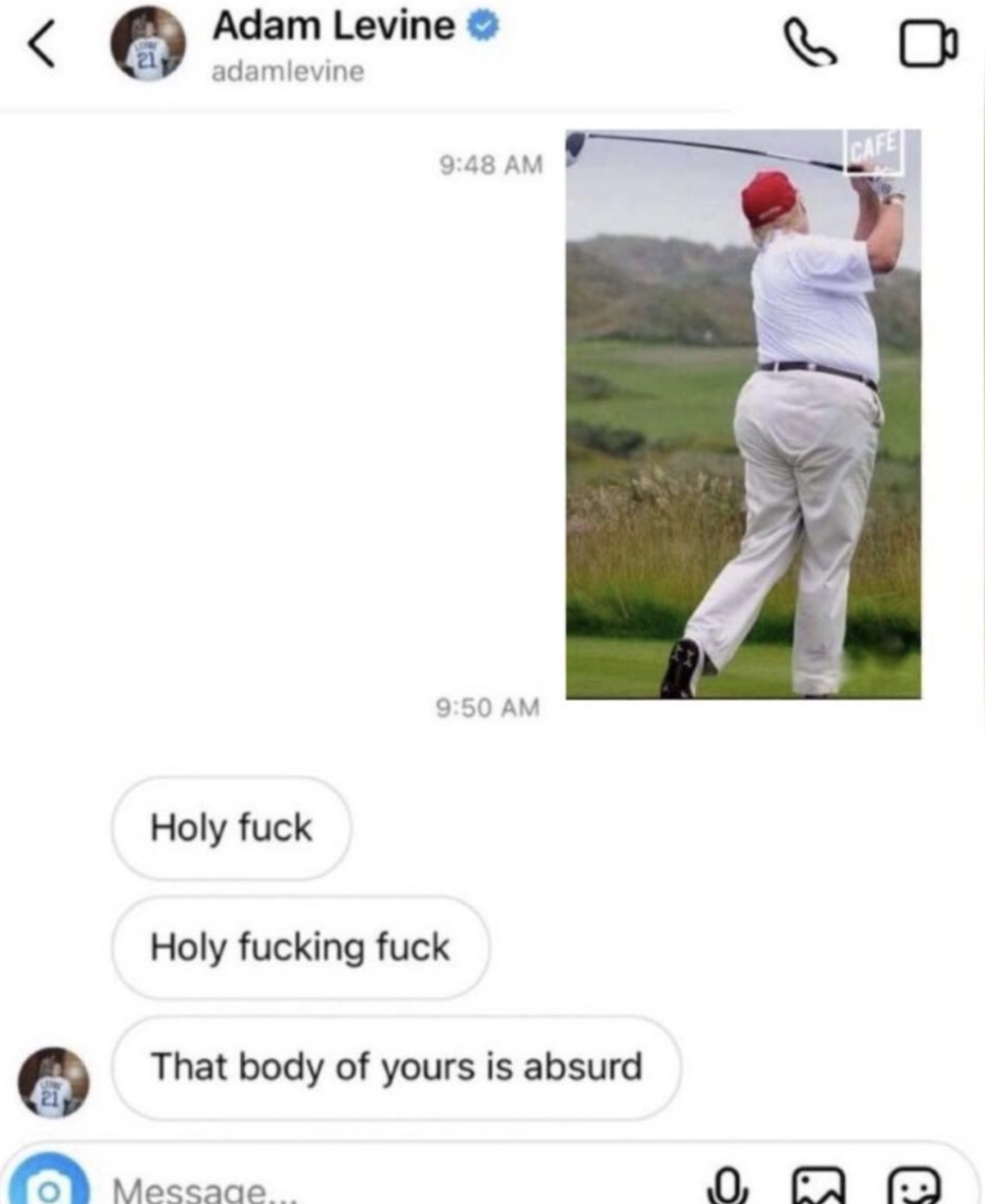
35 points29 points28 pointsThat would be my wife: I’m in a meeting and my wife is blowing my phone up with texts and calls, so I step out to call her back. Me: Is everything OK? Wife: I ran over a cone and now I’m dragging it under the car and everyone is staring at me. Me: Drive it so two wheels are up on the curb and pull the cone out Wife: OK, bye I walk back into the meeting and remember that she was driving my truck with a 4” lift that day and I’m wondering how in the hell a cone could get stuck under it. Then she sends me this, declaring victory over the “cone”: I’m surprised there wasn’t a construction worker mangled in the grill when I got home.28 points25 pointsIs anyone really that surprised that someone that willingly joined a cult as a youth is fully submerged in another as an adult?!?25 pointsThis is irritating AF, and I know I shouldn't care, but it coming from a fucking Texags site is even richer. "Texas is doing everything it can to destroy the Big 12." Motherfucker, after aTm left we literally closed ranks and SAVED the Big 12. Held it together with our fucking largesse for a decade. And all we got was shitty conference partners, shittier recruiting, shitty refs that love to fuck over UT, and about 900 11 am fucking starts. And when we leave for greener pastures, EXACTLY the same decision aTm made, we're the assholes who did everything to destroy the big 12. Get fucked, you losers.24 pointsare we inviting or are we exchanging? because i have a list.22 pointsYeah, I care what texags thinks about this issue about as much as I care what Insane Clown Posse thinks about magnets.19 points18 pointsMy wife hit a python today while on the phone with me. It was at chic fil a. It was an orange cone. She really said python.18 points18 points18 points17 pointsThe government provided affidavits regarding what was recovered during the raid. Trump could have provided an affidavit indicating, for instance, what items he believed were taken but not listed, or an affidavit explaining that he mixed up all those documents so that personal items (e.g., attorney-client privileged material or medical records) could be in the folders labeled classified , or maybe an affidavit stating that he had declassified the documents (but, as you and the 11th circuit have noted, that is a bit of a red herring). These sorts of proceedings do generally get resolved like summary judgment, so affidavits and then like work so long as it is clear that they could be converted to an admissible form and there are no objections to them. And, if needed, the court can also take live testimony. There are two major things I think you have missed from beginning: 1) This involves a criminal proceeding in the investigatory phase. Almost all of the cases cited by Cannon (as I pointed out earlier in the thread), dealt with criminal proceedings that had completed. The ability to get such evidence returned or to refrain the government from using it is necessarily limited both due to equity and separation of powers. 2) Trump had the burden of demonstrating an possessory interest in the documents. He kept arguing the reverse, i.e., that the government had to prove that Trump didn't have a possessory interest. Cannon bought it. The 11th Circuit wasn't having it.17 pointsHe ain’t suffering these fools16 pointsCannon did something TFG liked. The 11th Cir. undid some important elements of that, TFG didn't like it. TFG had an avenue to appeal the 11th Cir. action to the SCOTUS. Cannon just revoked the things the 11th Cir. ruled on (that is, the things the 11th cir. told her she couldn't do). Since those provisions of her order no longer exist, the 11th Cir ruling that he would have appealed is now moot (it's not a thing anymore). TFG would have to appeal Cannon's NEW, revised order....to the 11th Cir.....which would uphold it.....and THEN he might could appeal that to the SCOTUS. BUT, it's much harder to appeal this new order by Cannon, as it is well within the scope of her discretion/the applicable legal standard. CONCLUSION: TFG no longer has a good path to appeal the special master order to the SCOTUS. And in any case, the special master's review will likely be done well before that appeal could get there.16 points16 points16 points16 points16 points16 points15 pointsRussia not the only one in the referendum game. Netherlands putting together their own version declaring Russia belongs to them. Glory to King Willem-Alexander!15 points15 points14 points14 points14 pointsFirst of all, I agree with your thoughts in this post. A lot of the media guys are damned near overtly cheering for him, which sucks for us if he doesn't succeed because all we're hear about from them is that something is wrong at Texas. Herbstreit and Sarkisian are buddies and he can't wait to pimp the guy when he gets a chance. I think Leinart and Bush really like him as well. Same for Finebaum. As it pertains to my views on Sarkisian, I'd just like to point out that as a person, I like him just fine. I've had the chance to be around him in private and he's legitimately a nice, fun, interesting guy. As a coach, my view on him is not complicated by any of that and isn't complicated in general. He shit the bed last season. It wasn't all culture-related. They got outcoached in multiple games. His history gives me no reason to give him the benefit of the doubt thus far. That considered, all he needs to do is win. Win, and then build on that and win more, and then get us into the CFP picture regularly. If he does that, I'm all for him retiring at Texas in 30 years having built a dynasty. Folks can unintelligently throw old posts of mine in my face when they let me online in the old folks home. Don't care. Win.14 points14 points14 pointsI declassified it in my head14 pointsI’ve always pictured ctj and Sydney like this14 points13 points13 points13 points12 pointsI know it's been discussed a thousand times in this thread, but the lack of Russian air superiority is absolutely mind bottling. They've been bluffing with their nukes for 40 years. They have fuck all and they are showing their ass to the world.12 points12 pointsProtesters need to string some 100lb test monofilament line across the street at neck level.12 points12 points12 points12 points@Ag with kids I am reading all your posts on the raid on Texags. How about making all those asinine claims here?12 points12 pointsThis is a pretty telling post by Billdo. 1) He's got nothing left in the tank when it comes to "just wait, big commitments are coming." They're up shit creek on the big game hunting aspect of recruiting OOS this cycle and he knows it. 2) He's whining about others having money and poor ATM can't spend in the same way. He's been doing this, but it's just more evidence of the fact that they don't have an endless spigot for the program from the booster side. They're fighting against the portal and in recruiting after blowing major dollars last cycle. Everyone wants to see them slapped down for it, and everyone has the money to do so. 3) The last remaining strategy being espoused by the coaching staff and fed to Liucci is "hey, all we gotta do is win and things will turn out okay" but that's basically just hope as a strategy. No shit winning helps. The counter to this is - if they don't stack wins up like they need to, guys like Hill are in jeopardy. If Hill's options are less money up front but being a star on a winning team on the rise with corporate options for stars, or taking the max up front and settling in for 6-6ish at Portal U in BCS, the big dick money flop from July might not matter. People on our side have a lot of confidence that Hill can be flipped IF Texas puts together a strong season and ATM shits the bed. I don't think they have the money to take Toviano, Hicks, Owens, and Hill in this cycle, plus retain everyone they want on their roster. I won't be completely surprised with a Hill decommit and that money slung at Owens and Bowen immediately to offset it. Hicks winds up at OU. Toviano will get whatever he wants wherever he wants to go, so I assume that winds up being LSU for whatever reason. If ATM had 2022 cycle money to sling this cycle, all of those guys wind up signing with ATM except maybe Toviano.12 points12 pointsKey section of the Eleventh Cir. panel opinion (in addition to the standing argument that Trump had no property right to the documents). No doubt the threat of prosecution can weigh heavily on the mind of someone under investigation. But without diminishing the seriousness of that burden, "if the mere threat of prosecution were allowed to constitute irreparable harm . . . every potential defendant could point to the same harm and invoke the equitable powers of the district court." United States v. Search of Law Office, Residence, and Storage Unit Alan Brown, 341 F.3d 404, 415 (5th Cir. 2003) (quotation omitted). If this concern were sufficient to constitute irreparable harm, courts' "exercise of [their] equitable jurisdiction would not be extraordinary, but instead quite ordinary." Id. Cannon should be embarrassed.12 pointsGet outta here with your Critical Wealth Theory!12 points11 points11 points11 points11 points11 points11 points11 points11 points10 points10 points10 points10 pointsYes. They messed with the established order, even as that order has shifted towards figuring out NIL, which is the wild west for everyone. So they pissed everyone off, lied about what they were doing while mocking the NIL emergence, and have been left completely flatfooted with a giant "kick me" sign on their back. There aren't a bunch of people in the CFB coaching ranks cheering for Jimbo Fisher.10 points…and that is a Gif of Bert on a Sybian.10 pointsThis leaderboard is set to Chicago/GMT-06:00Football ... Basketball ... Baseball ... Other Sports ... Futbol ... 🤫995🤫 ... Gambling ... Movies & TV ... Music ... Hobbies ... Lulz ... Food & Travel ... Daily Texan ... Business & Markets ... Cloak Room ... Help ... For Sale ... Board Discussion ... Advertise... Tailgate Donations
Account
Search
Configure browser push notifications
Chrome (Android)
- Tap the lock icon next to the address bar.
- Tap Permissions → Notifications.
- Adjust your preference.
Chrome (Desktop)
- Click the padlock icon in the address bar.
- Select Site settings.
- Find Notifications and adjust your preference.
Safari (iOS 16.4+)
- Ensure the site is installed via Add to Home Screen.
- Open Settings App → Notifications.
- Find your app name and adjust your preference.
Safari (macOS)
- Go to Safari → Preferences.
- Click the Websites tab.
- Select Notifications in the sidebar.
- Find this website and adjust your preference.
Edge (Android)
- Tap the lock icon next to the address bar.
- Tap Permissions.
- Find Notifications and adjust your preference.
Edge (Desktop)
- Click the padlock icon in the address bar.
- Click Permissions for this site.
- Find Notifications and adjust your preference.
Firefox (Android)
- Go to Settings → Site permissions.
- Tap Notifications.
- Find this site in the list and adjust your preference.
Firefox (Desktop)
- Open Firefox Settings.
- Search for Notifications.
- Find this site in the list and adjust your preference.